 Every Lake
To winterize a lake cabin, work in this order: shut off and drain the water system, protect the traps and fixtures with non-toxic antifreeze, turn off or lower the water heater, pull the dock and boat before the ice arrives, seal the building against mice and moisture, and leave the house in a state you can check from a distance. The plumbing is the part that costs real money when it goes wrong, so start there and do it on a day that is above freezing.
The rest of this guide goes through each of those steps in the order most people do them, with the small reasons behind each one. After the checklist there is a section about the quieter side of closing up: the drive home, and what to put on a wall so the lake does not disappear from the house between October and May.
Start with the water, because water is what breaks things
A pipe does not burst when ice forms inside it. It bursts when ice seals one end and keeps growing toward the other, so the pressure has nowhere to go. That is why draining matters more than heat.
- Shut off the supply at the main valve, or at the pump if you are on a lake-water or well system. Disconnect and drain the hose from the intake if you pull from the lake.
- Open every faucet, hot and cold, upstairs first, then the lowest tap in the building so gravity can do its work. Open the outdoor spigots and leave them open.
- Drain the water heater. Turn off the breaker or the gas first, then attach a hose to the drain valve and open a hot tap to let air in. A tank left full in an unheated cabin is a tank waiting to split.
- Blow out the lines if the layout has long runs or low spots. A small compressor at low pressure, roughly 30 to 40 psi, pushed through each fixture in turn until only air comes out, clears what gravity leaves behind. Do not go higher than that on old plastic or soldered copper.
- Pour non-toxic RV antifreeze into every trap: sinks, tub, shower, floor drains. Add a cup to each toilet bowl and flush the tank dry first. Use the pink propylene glycol kind sold for RVs, never automotive antifreeze, which is poisonous and will end up back in the lake through your septic or drain field.
- Disconnect the washing machine and dishwasher hoses and drain the pumps. These hold more water than people expect.
If the cabin has a pressure tank, drain that too. If you are not sure where a section of pipe runs, assume it holds water and treat it that way.
The dock, the boat and the shoreline
Ice does not need to be thick to do damage. Moving sheets of it push sideways against posts, and ice that freezes to a post will lift the whole thing a little each time the water level changes. Sectional docks come out in autumn for this reason: unbolt them, stack them above the high-water line, and lay down a plank or two so the ends are not sitting in wet ground.
Some lakes change level on their own schedule, and it is worth knowing yours. Candlewood Lake in Connecticut was made in 1928 by pumping a river uphill, and it is a working reservoir, so the shoreline you left in September is not always the one you find in spring. Docks, boat lifts and anything tied to the bank need to be set with that in mind. Check what the owner of your own lake does each fall, because a lowered lake can leave a floating dock sitting on the bottom.
- Boat: stabilize or drain the fuel, change the oil, drain the lower unit and the engine block, and store it out of the water. Shrink-wrap keeps snow out of the cockpit.
- Lifts and floats: raise lifts fully, pull swim rafts and anchor ropes, and bring in anything that can be carried off by ice.
- Docks that stay in: some owners use bubblers or de-icers to keep a ring of open water around posts. Rules on these vary by state and by lake association, so ask before you buy one.
- Shoreline: walk it once. Note where the bank is eroding, because spring melt will show you the same spots again.
Lakes with long, cold winters make this chore urgent. Lake Winnipesaukee in New Hampshire is 77.1 square miles of water with some 250 islands, and its roughly 180 feet of depth sits under a surface that freezes hard across the bays. People who close a cabin there tend to do it early, in October, and leave nothing in the water that they want back.
Keep the building dry, not warm
Most winter damage to a closed cabin is moisture rather than cold. A shut-up house with damp towels, a wet basement floor or a full refrigerator will grow mold by April.
- Empty the refrigerator and freezer, unplug them, and prop the doors open. A small box of baking soda in each helps with the smell.
- Wash and dry linens, then store them in sealed plastic bins or hang them in a closet. Stand mattresses on their edges or cover them with breathable cotton, not plastic.
- Close the flue and the damper. Check the chimney cap. Cover or plug any open stovepipe holes.
- Put a moisture absorber in closets and the crawl space, and check that the crawl space vents are set the way your cabin needs them.
- Clear the gutters, because a gutter full of leaves holds ice against the fascia all winter.
If you keep power on, set a thermostat to hold the house somewhere around 45 to 50 degrees. That is a decision about your electric bill and your insulation. A house that is drained does not need heat to stay safe, and a house that is heated needs to be watched.
Mice, squirrels and everything else that wants in
A cabin full of cedar paneling, closed in a cold month, looks like an invitation. Mice can pass through a gap about the width of a pencil. Walk the outside slowly and look for gaps around pipes, vents and the sill. Stuff steel wool into the small ones and cover it with caulk, because steel wool alone rusts away. Screens go over chimney tops and dryer vents.
Inside, nothing edible should stay. Cans are fine, but flour, cereal, pet food, birdseed and even soap are not. Put what you cannot take home into metal or hard plastic bins. Some owners set traps and check them once in midwinter; others leave a few bait stations. Whichever you pick, put the instructions on the kitchen counter so you do not forget them in spring.
Safety, power and the paperwork nobody remembers
- Turn off propane at the tank and shut the gas supply. Close the main breaker, or switch off everything except what you want running, such as a sump pump or a thermostat.
- Test the smoke and carbon monoxide detectors, and put in fresh batteries. If the cabin is unattended, a monitor that texts you about temperature or power loss is worth having.
- Check your insurance. Many policies have language about how long a property can sit vacant or unheated, and what the owner must do before leaving. Read it before the first snow, not after a claim.
- Tell a neighbor, and leave them a key and a number. The person who plows or checks the road is the person who will notice a branch through a window.
- Photograph every room before you leave. It takes ten minutes and tells you in April whether anything has changed.
The last walk-through
Go through the cabin with this list in your hand, because tired people leave things behind. Taps open. Water heater drained. Antifreeze in the traps. Fridge propped. Gas off. Flue closed. Windows latched, curtains drawn to keep sun off the furniture, and the door locked behind you.
Then stand on the dock, or where the dock was, for a minute. Most people do this without planning to. The lake in November is flat and metal-colored and not quite the lake you spent the summer with, and you are about to leave it for half a year.
Keeping the lake with you
This is the part of closing up that no checklist covers. Cabin owners talk about the drive home in a particular way: the last look in the mirror, and then a house in the city where nothing says water. Some people keep a jar of stones on the windowsill. Some hang a chart. A growing number choose a depth map, which shows the lake the way you never see it: from above, with the drop-offs and the shelf where the bass stay in July.
It works because a depth map is a story people can read. You find the point where you swim, and you find that ten feet out the bottom falls away. On Torch Lake in Michigan, which runs nineteen miles and reaches about 310 feet, the sandbars are a pale shelf near shore and then a long fall into dark water. A map shows that in layers.
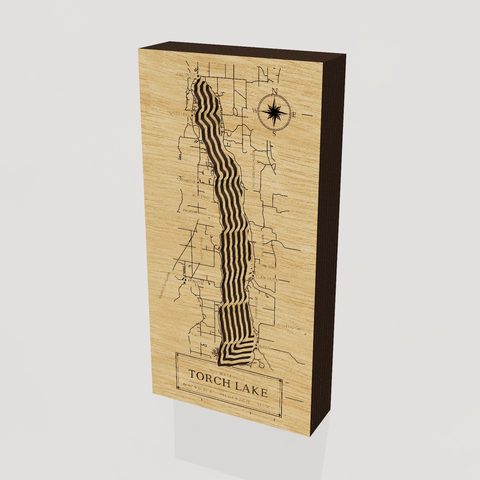 Torch LakeMI · 3D wood depth map · from $149
Smaller lakes read well in wood too, because every contour has room to breathe. Walloon Lake near Petoskey, about 100 feet deep, is Hemingway's boyhood water, a long hooked shape with a basin you can pick out at a glance.
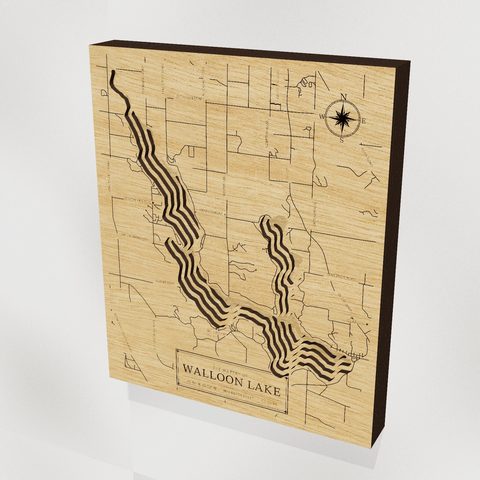 Walloon LakeMI · 3D wood depth map · from $149
If you own a cabin on a larger lake, the map becomes a way of seeing the whole place at once. Chautauqua Lake stretches seventeen miles and reaches about 78 feet at its deepest, and a map puts the narrows in the middle, the northern basin and the southern one side by side. If yours is a small kettle lake in the hills, such as Edinboro Lake with its 30 feet of water, the map is the whole lake, edge to edge, in one frame.
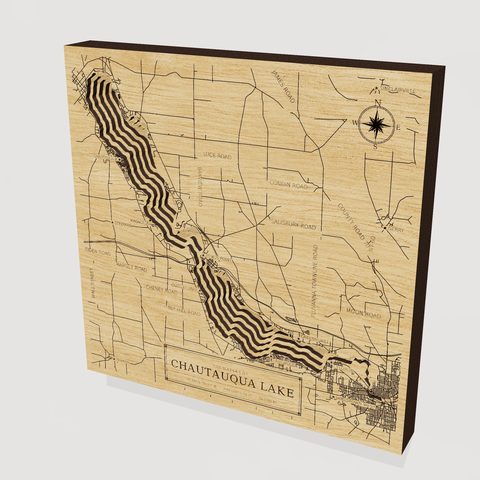 Chautauqua LakeNY · 3D wood depth map · from $149
How to choose a size and word the line
The 12-inch map ($149) fits a shelf or a mantel, and suits a small lake or a bedroom wall. The 17-inch ($249) is the one most people hang over a couch or in an entry. The 24-inch ($399) and 30-inch ($599) work as a centerpiece for a great room, and they carry more of the shoreline's detail, such as roads and small coves.
The personal line is usually the family or cabin name, such as The Hendersons, Since 1974 or just the name painted on the cabin sign. A short message can be a date, a set of coordinates or two words only the family would understand. A star goes on any spot along the shore, and the favorite choice is the dock, because that is where the cabin is, even in January.
If you want a lake we do not list on the site, search for it at search, or ask us to make it through commission. You can also browse among the lakes we map at all lakes, and the other pieces at guides.
A note on what we make
Every Lake makes layered, laser-cut birch depth maps of real US lakes in Waterford, Pennsylvania. Each layer of wood is a depth contour, and shore roads and towns are engraved across the top. Maps ship free in the lower 48 about 7 to 10 days after you order, and they are decorative pieces, not charts for the water. One of the quieter reasons people order one in autumn is the one above: the cabin is closed, the lake is gone, and a wall in the other house is waiting for it.


