 Every Lake
Among the lakes we map, the deepest Pennsylvania water is Lake Erie at 205 feet, followed closely by Raystown Lake at 200 feet. Erie is shared with four other jurisdictions, so Raystown is the deepest lake that sits entirely inside the state. Next come the Allegheny Reservoir at 130 feet and Harveys Lake at 102.
As for how deep Lake Wallenpaupack is, the figure we have is 60 feet at its deepest. That surprises people, because it is such a big lake. It is long and wide, but not deep. The rest of this guide explains why, and what depth does to a lake you love.
The deepest lakes in Pennsylvania, ranked
This ranking uses only the maximum depths we have on file. It covers the lakes we map and is not a count of every lake in the state. Many Pennsylvania lakes have no depth we can stand behind yet, so they are left out of the numbers rather than guessed at.
| Lake | Max depth |
|---|---|
| Lake Erie | 205 ft |
| Raystown Lake | 200 ft |
| Allegheny Reservoir | 130 ft |
| Harveys Lake | 102 ft |
| Conneaut Lake | 80 ft |
| Lake Winola | 70 ft |
| Lake Wallenpaupack | 60 ft |
| Fairview Lake | 48 ft |
| Canadohta Lake | 46 ft |
| Lake Arthur | 36 ft |
| Pymatuning Reservoir | 35 ft |
| Edinboro Lake | 30 ft |
| Lake Jean | 20 ft |
Notice that the top of the list is mostly water made by people. Pennsylvania sits on the edge of the last glaciation, so it has far fewer natural lakes than Minnesota or Michigan. The deep water here was mostly made by engineers who flooded a valley.
Lake Erie: the big, shallow one
At 205 feet and more than ten thousand square miles, Lake Erie is the deepest entry here. It is also the shallowest of the Great Lakes. The 205-foot figure belongs to the lake as a whole, which Ohio, Pennsylvania, New York, Michigan and Ontario all share. It is not a measurement taken off Presque Isle.
That shallowness explains the lake's character. Shallow water warms fast and mixes in a stiff wind, so Erie turns brown and choppy after a storm. It freezes over in a hard winter, and it grows the walleye the region is known for. A depth map of Erie shows a gentle basin with a few long, slow ridges. Wood layers cut from it stack differently than they would for a mountain lake, with the contours spread wide and the drop-offs subtle.
Raystown Lake: Pennsylvania's deep reservoir
Raystown holds the state's deepest water inside its own borders, at 200 feet. The Army Corps of Engineers dammed the Raystown Branch of the Juniata River in the early 1970s. The flooded valley drowned the old farm roads and left 118 miles of forested shoreline.
A flooded river valley is deepest at the dam, where the old channel runs straight down. The water then climbs the valley walls in a series of ridges and coves. On a layered map, Raystown reads like a branching tree, with a narrow dark trunk of deep water near the dam and a lot of pale wood at the edges. If you grew up here, the shape is probably familiar before you can name a single contour.
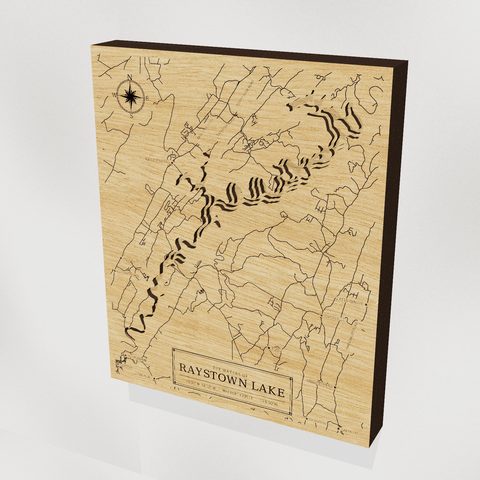 Raystown LakePA · 3D wood depth map · from $149
Allegheny Reservoir: the Kinzua lake
The Allegheny Reservoir reaches 130 feet and runs about 27 miles up the river into New York. Kinzua Dam backs it up, and the flooded valley is steep and narrow. Steep banks mean deep water close to shore, and a map of it looks stretched, with the contours packed tight on both sides of a long, thin channel.
Harveys Lake and the natural lakes
Harveys Lake is the largest natural lake in Pennsylvania by volume, and it is 102 feet at its deepest. It lies above Wilkes-Barre, and glaciers made it. That is a different kind of depth from a reservoir's. A glacial lake has a bowl-shaped bottom, round and smooth, with no old river channel running through it. On a layered map the contours sit in loose rings, one inside another.
Deep, cold water has practical effects, too. A lake that deep stratifies in summer. The surface warms, and the bottom stays cold and dark. Cold-water fish such as lake trout need that bottom layer. Deep lakes also tend to be clearer, because there is less bottom to stir up and more room for sediment to settle. When ice comes, deep lakes freeze later and thaw later than shallow ones.
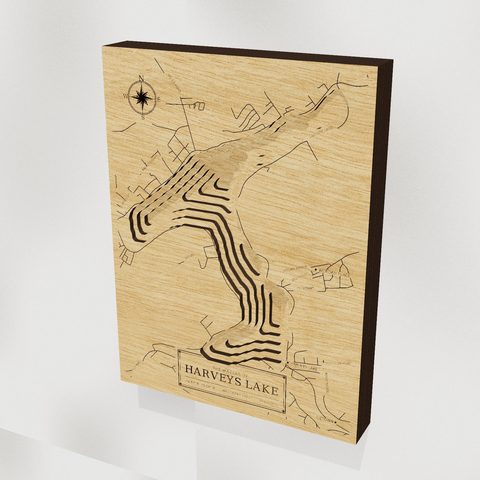 Harveys LakePA · 3D wood depth map · from $149
Conneaut Lake, Pennsylvania's largest natural lake, drops to 80 feet. It sits in Crawford County, and the old amusement park stands at its north end. In the Endless Mountains, Lake Winola is another glacial lake, at 70 feet, even though it covers a fraction of Conneaut's area. Size and depth are different things, and small glacial lakes are often the surprise on a ranked list.
How deep is Lake Wallenpaupack?
Lake Wallenpaupack is 60 feet at its deepest. PPL built the dam in 1926, and the lake backs up thirteen miles through the Poconos. The deepest water lies close to the dam, where the old Wallenpaupack Creek valley was lowest. Farther up the lake, the water is much shallower, and the coves where the creek's side valleys were flooded are shallower still.
That is why Wallenpaupack feels bigger than its depth suggests. It has long shoreline, many bays and miles of open water, but not much vertical drop. For a layered map, this is a pleasure. Sixty feet of depth cut into birch layers gives a landscape of fine stepped contours, with the dam end darkest and the upper arms pale and intricate. Families who have a place on one of those arms often want the star engraved exactly there.
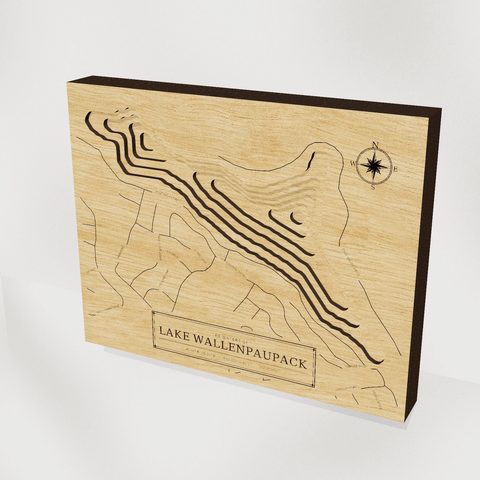 Lake WallenpaupackPA · 3D wood depth map · from $149
The smaller lakes with real depth
Some of the most-loved lakes in the state fall below the top of the ranking. Fairview Lake, near Scranton, is 48 feet deep. Canadohta Lake, between Union City and Titusville, is 46. Lake Arthur at Moraine State Park is 36, and the broad Pymatuning Reservoir on the Ohio line is 35. Edinboro Lake, a glacial kettle with a college town on its shore, is 30, and Lake Jean is 20.
Those shallower lakes make good maps for a different reason. Twenty or thirty feet of depth still makes three or four visible layers, and the shoreline, which is engraved on top, carries more of the picture. A map of a small lake is mostly about the shore, the roads, the cove where the dock sits.
Choosing a size and wording the personal line
Depth decides how much the layers show. Our four sizes are 12 inches at $149, 17 inches at $249, 24 inches at $399 and 30 inches at $599, with free shipping in the lower 48. A deep lake such as Raystown or Erie reads well at 17 inches or larger, where the contours have room to separate. A small lake with a long shoreline can be lovely at 12 inches because there is less to fit. If the map is a gift for a mantel, 17 inches is a comfortable size. A bigger wall wants 24 or 30.
At checkout you can add a family or cabin name line, a short message, and a star on any spot on the shore. The name line works best when it is short and sounds like the place, such as the name painted on the dock sign. The message can be a date or coordinates, or a few words that mean something to the person receiving it. The star is the part people remember. Put it on the cove, the point or the porch, wherever the summers happened.
About Every Lake maps
Every Lake makes layered, laser-cut birch depth maps of real lakes in Waterford, Pennsylvania. Each wood layer is a depth contour, and shore roads and towns are engraved on top. Pieces ship in about seven to ten days. If your lake is not one we have already drawn, you can search for it among more than 104,000 US lakes, or ask us to make it. You can also browse all the lakes or read our other guides.


