 Every Lake
Among the Michigan lakes we map with a surveyed depth, Crystal Lake in Benzie County is the deepest inland lake, at 165 feet. It sits just behind the Sleeping Bear dunes, and it is a good answer to the question most people ask first, which is how deep is Crystal Lake, Michigan. The surveyed maximum is 165 feet, and that number belongs to one small spot far from shore.
Behind it come Mullett Lake at 144 feet, Glen Lake at 130, Lake Charlevoix at 122 and Lake Leelanau at 121. This is a ranking among the lakes we have mapped, not a census of the state. Michigan has thousands of inland lakes, and some we have not listed a depth for may run deeper. If yours is missing, search for it and we can make it.
The ranking, from the lakes we map
Every figure below is a surveyed maximum depth, the single deepest sounding on the lake. Area is the surface of the whole lake. Lakes where we have no surveyed depth on file are left out of the ranking. That says nothing about whether they are deep, only that we will not guess.
| Lake | Surveyed max depth | Area |
|---|---|---|
| Crystal Lake | 165 ft | 15.4 sq mi |
| Mullett Lake | 144 ft | 26.4 sq mi |
| Glen Lake | 130 ft | 9.8 sq mi |
| Lake Charlevoix | 122 ft | 27.0 sq mi |
| Lake Leelanau | 121 ft | 8.9 sq mi |
| Gull Lake | 110 ft | 3.3 sq mi |
| Walloon Lake | 100 ft | 7.1 sq mi |
| Burt Lake | 73 ft | 27.0 sq mi |
Notice that size and depth do not track each other. Burt Lake and Lake Charlevoix cover the same surface, about 27 square miles, yet one bottoms out at 73 feet and the other at 122. Gull Lake is the smallest on the list and still passes 100 feet.
Crystal Lake: the deepest of the group
Crystal Lake is nine miles of blue water in Benzie County, and at 165 feet it is the deepest inland lake in our Michigan set. A lake this deep and this clear makes a striking layered map, because the contours stack into a tall, steep-sided bowl. You can see the whole story of the basin in the wood: a shelf along the shore, then a sudden drop.
A basin like that tends to be clear. Deep water holds fewer nutrients per gallon, so algae stay thin and light travels farther down. That is why the water looks blue from the sand and nearly black over the deepest part. The lake's name is plain description.
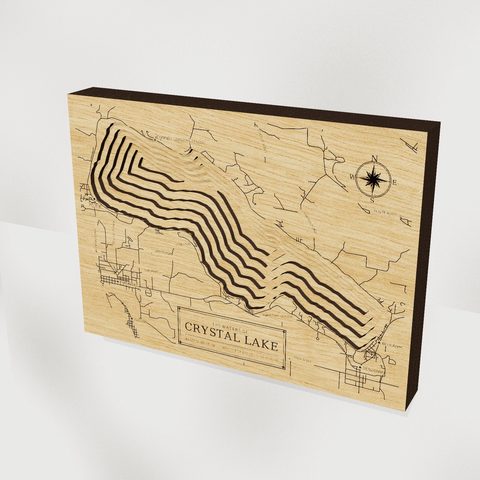 Crystal LakeMI · 3D wood depth map · from $149
Mullett Lake and the Inland Waterway
The second-deepest on our list is Mullett Lake, at 144 feet. It is Michigan's fifth-largest inland lake, near Cheboygan, and it forms part of the Inland Waterway with Burt Lake to the south. The two lakes are connected, and they could hardly be more different underwater. Burt is broad and comparatively shallow at 73 feet. Mullett drops to nearly twice that.
Anglers know this difference. A shallow lake warms quickly and grows weeds across much of its floor. A deep one keeps cold water in reserve for species that need it, which is why people who fish Mullett talk about depth and drop-offs rather than just the weed line.
Glen, Leelanau and Charlevoix: the Sleeping Bear and Antrim neighborhood
Three of the next four lakes sit in the northwest Lower Peninsula, where glaciers carved long troughs and left them full. Glen Lake reaches 130 feet behind the Sleeping Bear Dunes. Lake Leelanau runs twenty-one miles down the middle of its peninsula in a narrow channel and reaches 121 feet. Lake Charlevoix reaches 122 feet, and its far end opens into Lake Michigan.
Leelanau is the clearest example of why width tells you little. At under nine square miles of surface it is a thin ribbon, but a ribbon with a deep keel. Charlevoix and Leelanau differ by a single foot in surveyed depth, so treat their order as a near tie.
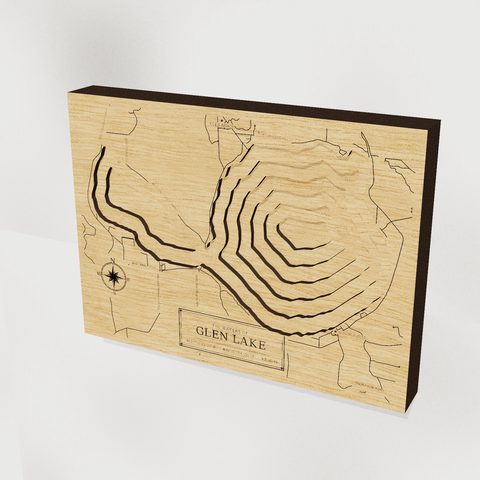 Glen LakeMI · 3D wood depth map · from $149
Gull and Walloon: deep lakes with small footprints
Gull Lake near Kalamazoo is only 3.3 square miles on the surface, yet it is surveyed at 110 feet. Walloon Lake, the hills-above-Petoskey lake Hemingway knew as a boy, is surveyed at 100 feet across 7.1 square miles. These are the lakes where depth surprises people. A short boat ride from the dock can put you over water deeper than a ten-story building is tall.
On a layered wood map, a compact deep lake is a satisfying object. The layers are close together at the edges and the stack is tall relative to the footprint, so the carving reads clearly even at the smallest size.
How depth shapes a lake
Color
Depth and clarity work together. Deep, low-nutrient lakes tend toward blue and green. Shallow lakes with soft bottoms, such as Lake St. Clair at a surveyed 27 feet, look greener or browner because wind stirs the bottom and algae thrive in warm water. Compare that with Lake Erie, a Great Lake whose deepest sounding is 205 feet but which is shallow across most of its width. A large lake can still be a shallow one, and Erie's reputation for sudden storms comes partly from that.
Fish
In summer, a lake deep enough to stratify separates into a warm top layer and a cold bottom layer, with a sharp thermocline between them. Cold-water fish such as lake trout and cisco need the cold layer to stay oxygenated, so they favor the deepest basins. Shallow lakes tend to favor warm-water fish like bass, bluegill and walleye. Depth is one of the first things a fisheries biologist checks.
Ice
Deep lakes freeze later and thaw on their own schedule. They hold a large body of water that must cool before ice can form, so the first hard freeze often arrives a week or two after the shallow lakes nearby. A tall pile of birch layers is a decent way to see why.
Lakes where we do not list a depth
Several famous Michigan lakes are on our roster without a surveyed depth, so we do not rank them. Torch Lake, nineteen miles of Caribbean blue, and Higgins Lake near Cadillac are two of them. Houghton Lake is the state's largest inland lake by area, 31.3 square miles, and Lake Gogebic is the largest natural inland lake in the Upper Peninsula. Houghton Lake is the reminder that biggest and deepest are different questions. Treat our list as the lakes we have depth numbers for, not as the final word.
Choosing a size for a deep lake
Depth shows best when there is room to carve it. For a long, narrow lake like Leelanau, the 24-inch map ($399) gives the channel room to read. A rounder lake like Glen or Gull is happy at 12 inches ($149) as a desk or shelf piece, or 17 inches ($249) for a wall. The 30-inch ($599) suits a mantel or a lake house entry.
For the personal line, short wording works best. A family or cabin name on the name line, a few words for the message, and a star on the spot that matters: the dock, the point where you swim, the cottage road. The star is the most personal part, and it reads well when the surrounding layers are deep and dark.
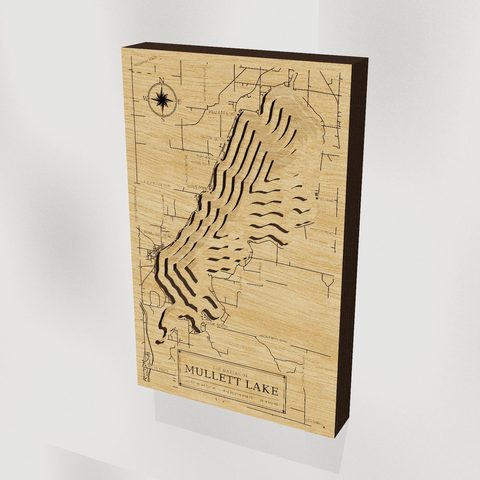 Mullett LakeMI · 3D wood depth map · from $149
About Every Lake maps
Every Lake makes layered birch maps of real lakes in Waterford, Pennsylvania. Each wood layer is one depth contour, with shore roads and towns engraved on top. A 165-foot lake and a 73-foot lake come out visibly different, which is the point. Maps ship free in the lower 48, usually in about 7 to 10 days. If your lake is not on the roster, ask us to make it, or browse all the lakes.


